A Scanner Tech’s Comparison: Noritsu vs Frontier vs Camera
It’s the slow season in the lab, and there are side quests to be had if one is enough of a nerd to accept.
Since coming aboard Blue Moon as a full-time scanner, I’ve spent quite a sum of time developing our newest method of film scanning — the camera scanner. Fine tuning the system and putting it through its paces to capture the more esoteric formats we work with (Minox spy film, for example) has allowed us to continue to highlight what there is to love about (in this case) tiny, tiny film — and broadly, any type of film that doesn’t fit in the average scanner.
A bulk of our scanning work is done with our trusty Noritsu HS-1800s, serving up Classic and Premium JPEGs and TIFFs all day long. Naturally, there is a draw to compare the results from our various scanners, in order to assure consistency across the board. Super-naturally, there is the scanner nerd draw to investigate this deeper, and loop in a silent rival from my lab tech past - the Fuji Frontier SP-3000. Thus springs an entirely subjective and somewhat silly visual comparison and high noon three-way duel, in blog form.
Let’s address the elephantine ghost in the room — BMC does not operate any Frontier scanners. Any opinion or example given here pertaining to the Frontier is supplied by my time in another lab. I spent nearly 5 years with my beloved SP-3000 — operating, maintaining, and hiding a picture of a burrowing owl inside it — so it’s safe to say we’re on a serial number basis. However, it’s not possible for me to go back and test with it, and the comparisons I can offer are limited to the images for which I have files to work with.
There are a number of conclusions I’ve made in this process, of which I can lump into two categories: (1) the user experience, advantages, and pitfalls of the machines in question, and (2) the aesthetic qualities of the scans and how they affect the scene. Let’s start the comparison.
The User Experience
I’ve always associated the Frontier scanners with their printer counterparts. After all, when I began my film lab career, the scanner was the controller for the printer. Meaning, as a digital system, one was able to sit at the scanner, “print” a roll, and it would immediately send files to the paired Frontier printer, and within a couple of minutes you’d have a fine set of chromogenic 4x6s hot and ready to go. This mode is modelled after printers like our own Nora — the difference being Nora shoots light through the film onto paper, no files needed. With this in mind, I assert that the SP-3000 produces scans that are “ready to print” — meaning images look fantastic right out of the gate. It’s easy to make people happy with a Frontier.
In my pre-Noritsu days, I looked upon them as if they were the Starship Voyager: small, sleek, flexible, and prestige quality. This turns out to be very true. Coming to it from the Frontier system, I approached the HS-1800 with the following quotes: “holy smokes, the 120 carrier is automatic??”, and “I don’t need a mask to change the ratio of my scans??”. As with the theme of its flexibility, it offers a ton of tonal control and can produce downright unnecessarily flat scans. This is fantastic for someone who values having control over the look of their images. But with great power, comes great responsibility — finding a happy place with a flat file often comes with a bit more work in post. Similarly, the smarts the Noritsu offers can sometimes be a drawback. Have a short strip of film with a single frame? Can’t do it, but the Frontier can. Want a true “capture” of your negative with no framing interpretation? The slit-scan Noritsu isn’t for you, but the Frontier is. Want to be able to scan sprockets and rebate for 135 and smaller formats? With some care and patience, you can do it — just with the Frontier.
The Frontier vs Noritsu duel is ultimately somewhat apples and oranges, and service-wise the question is sort of moot. Many labs operate both scanners for the same service price because they both produce very nice quality files similarly well from an operational standpoint. They’re fast, reliable, and easy to operate, and given their differences, a combination of the two in a lab would be complementary. Which begs the question… why am I about to bring in a camera rig?
The camera scanner fills the hole in my heart the Frontier left. If I run into a single frame in a paged scan order, I can take that one image to the camera and turn out a file that nicely matches the rest. If I want to scan my 135 sprockets and 110 rebates, I can do that with the camera. If I want a true sensor-to-frame capture of my film with no slit scanner interpretation, the camera is the only scanner in the building that can do it like the Frontier.
Shining in its own virtues, the camera rig offers better resolving power, truer grain representation, higher pixel dimensions, incredible tonal reproduction, and seemingly endless customizability. At root, it’s slower than high-capacity scanners, but I’ve seen rigs with automatic film carriers, which bring the concept closer to the speed of a Noritsu or Frontier. When paired with well designed image conversion software, like Negative Lab Pro, the image processing experience can be as simple as the Frontier’s “ready to print” scans, or as in-depth as Noritsu flexibility will allow and more.
The Aesthetic Experience
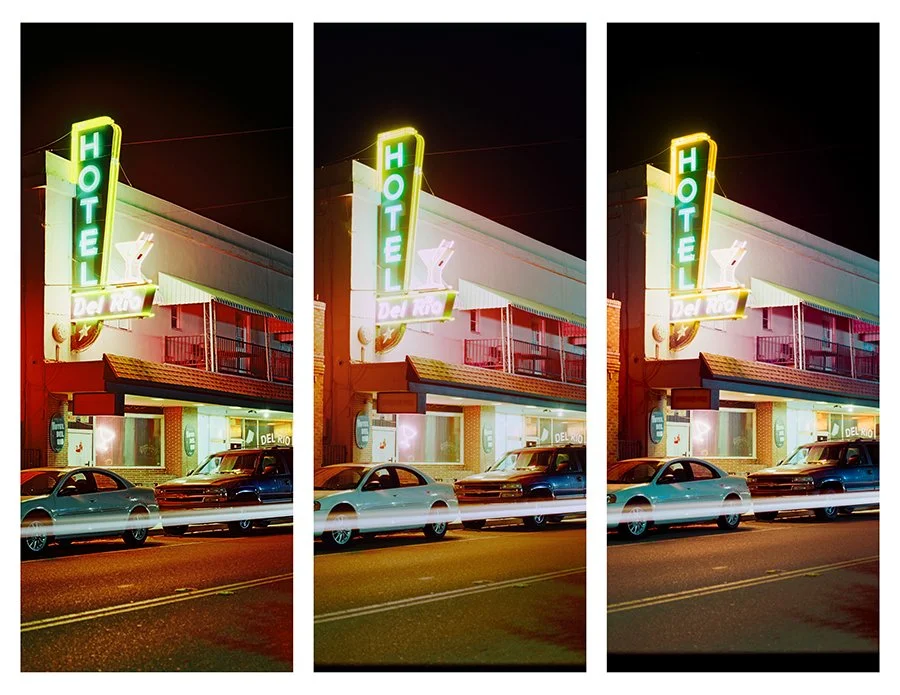
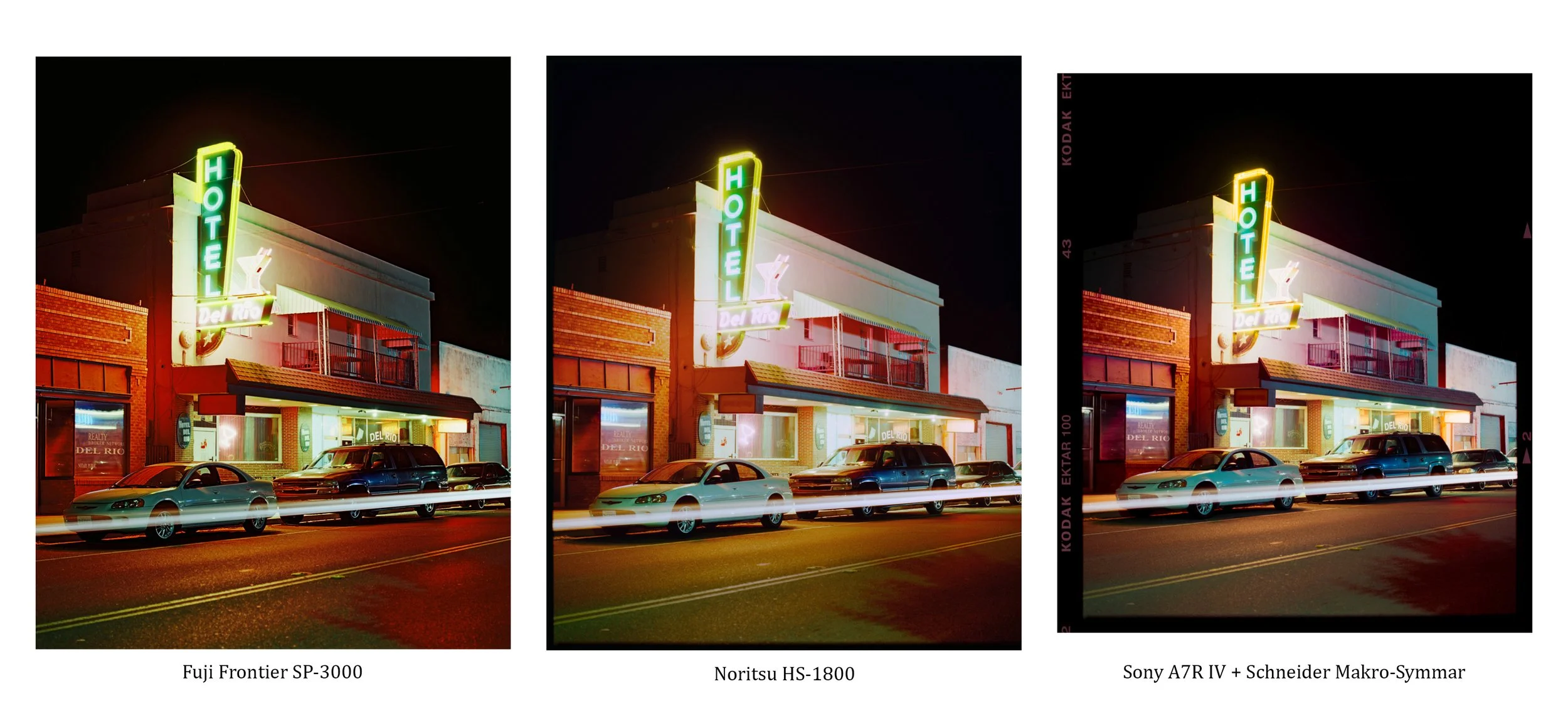
I admit, I’m hitting the comparison pretty heavy with this image. It’s vivid and high contrast — a summer night on the Sacramento river delta, caught on Ektar with some sharp Fuji GX680 glass. It may be a bit unfair, but I hope it highlights what these scanners do well, and what they don’t.
Starting on the left with the Frontier, it’s pretty rough. This is no attack on the Frontier in general, as for most scenes, that “ready to print” look gives nice levels of contrast and saturation. For high contrast scenes, however, it starts to get weird. At a distance, this image certainly has eye-catching qualities, but upon closer inspection, it looks a little crunchy. Upon even closer inspection, the details are getting quite blocky. And what’s with that car? It’s not a bad look, but as the photographer, it’s not the look I want.
In the center we have the Noritsu. Ah, some tonal room to breathe! I’m feeling better about how this represents my memory of that night and how I believe this particular film should be reproduced. Things look more natural for the most part, but there’s something about the color rendering that feels out of place. The neon certainly has a stylish glow, but the highlights feel clipped.
Finally, we have the camera scanner. Oh look! Edge-to-edge rebate! Okay don’t get distracted.. Wow, there’s so much usable information in this file! Such flexibility! It looks like that asphalt wasn’t quite as extraordinarily submerged in color as I was led to believe, but it looks natural and very pretty! The details look texturally complementary, not distracting. The neon looks properly gassy and classy, not halo-rific. Everything looks to be adding up to a cohesive and aesthetically pleasing image. Overall, this image feels representative of my intention as the photographer and as aesthetically balanced as the composition can provide. Too bad I have to spot all the dust out now.
A Lab Tech’s Perspective
To be transparent, I believe I have a niche perspective of the technology and the art of film photography that comes with working in photo lab production. Both my user experience and aesthetic tastes are situated from that viewpoint, and I have to highlight that there is a difference here than from the viewpoints of both the average film customer and the most studious of home scanning enthusiasts. I get to work with lots of fancy toys to make people happy with their images from a service-based profit standpoint. I value tools that provide efficiency, consistency, and quality to help me do my job, so the Noritsu HS-1800 is still mostly my best solution. To the home scanning enthusiast, there is no reason to not invest in a camera scanning setup, rather than hauling an office desk sized scanner like the SP-3000 into your home and dealing with archaic software, licenses, and random minilab forum threads. Again, I’m comparing apples and oranges, and.. pomegranates or something. It’s sort of a silly comparison because it entertains a practically silly situation, one which would probably not materialize for the average film shooter. But for me, it helps fill in the long hours of a slow workday.
// emi is a multidisciplinary artist and tech of many trades in Portland, Oregon. to keep up with more of their writing and photographs, see more at https://emi-amorphos.tumblr.com/